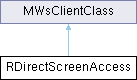
The interface between an application that directly accesses the screen and the window server. More...
#include <w32std.h>
Public Types | |
| enum | TTerminationReasons { ETerminateCancel , ETerminateRegion , ETerminateScreenMode , ETerminateRotation } |
| Provides the reason why direct screen access must terminate. More... | |
| enum | TPriority { EPriorityVeryHigh =2000 } |
| The priority of the active object that responds to notification that direct screen access must stop. More... | |
Public Member Functions | |
| IMPORT_C | RDirectScreenAccess () |
| Default constructor. | |
| IMPORT_C | RDirectScreenAccess (RWsSession &aWs) |
| C++ constructor with a connected window server session. | |
| IMPORT_C TInt | Construct () |
| Second phase constructor. | |
| IMPORT_C TInt | Construct (TBool aRegionTrackingOnly) |
| Second phase constructor. | |
| IMPORT_C TInt | Request (RRegion *&aRegion, TRequestStatus &aStatus, const RWindowBase &aWindow) |
| Issues a request to the window server for permission to perform direct screen access on a window. | |
| IMPORT_C void | Completed () |
| Indicates to the window server that you have responded to the completion of the request status passed to Request(), by stopping direct screen access. | |
| IMPORT_C void | Cancel () |
| Indicates to the window server that you have finished performing direct screen access. | |
| IMPORT_C void | Close () |
| Calls Completed() then deletes the server side resource and sets the client's handle to it to NULL. | |
 Public Member Functions inherited from MWsClientClass Public Member Functions inherited from MWsClientClass | |
| MWsClientClass () | |
| MWsClientClass (RWsBuffer *aBuffer) | |
| TInt | WsHandle () const |
| Gets the server side handle for the object. | |
Additional Inherited Members | |
| Protected Member Functions inherited from MWsClientClass | |
| void | Write (const TAny *aData1, TInt aLength1, TInt aLength2, TUint aOpcode) const |
| void | Write (const TAny *aData, TInt aLength, const TAny *aData2, TInt aLength2, TUint aOpcode, const TIpcArgs *aIpcArgs=NULL) const |
| void | Write (const TAny *aBuf, TInt aBufLen, TUint aOpcode, const TIpcArgs *aIpcArgs=NULL) const |
| void | Write (TUint aOpcode) const |
| void | WriteInt (TInt aInt, TUint aOpcode) const |
| void | WriteRect (const TRect &aRect, TUint aOpcode) const |
| void | WritePoint (const TPoint &aPoint, TUint aOpcode) const |
| void | WriteSize (const TSize &aSize, TUint aOpcode) const |
| TInt | WriteReply (TUint aOpcode, const TIpcArgs *aIpcArgs=NULL) const |
| TInt | WriteReplyInt (TInt aInt, TUint aOpcode, const TIpcArgs *aIpcArgs=NULL) const |
| TInt | WriteReply (const TAny *aBuf, TInt aBufLen, TUint aOpcode, const TIpcArgs *aIpcArgs=NULL) const |
| TInt | WriteReply (const TAny *aBuf, TInt aBufLen, const TAny *aBuf2, TInt aBuflen2, TUint aOpcode, const TIpcArgs *aIpcArgs=NULL) const |
| TInt | WriteReplyP (const TWriteDescriptorType &aReplyPackage, TUint aOpcode) const |
| TInt | WriteReplyIntP (TInt aInt, const TWriteDescriptorType &aReplyPackage, TUint aOpcode) const |
| TInt | WriteReplyP (const TAny *aBuf, TInt aBufLen, const TWriteDescriptorType &aReplyPackage, TUint aOpcode) const |
| TInt | WriteReplyP (const TAny *aBuf, TInt aBufLen, const TAny *aBuf2, TInt aBuflen2, const TWriteDescriptorType &aReplyPackage, TUint aOpcode) const |
| TInt | WriteReplyByProvidingRemoteReadAccess (const TAny *aBuf, TInt aBufLen, const TReadDescriptorType &aRemoteReadBuffer, TUint aOpcode) const |
| void | AddToBitmapArray (const TInt aBitmapHandle) const |
| void | AsyncRequest (TRequestStatus &aStatus, TUint aOpcode) const |
| TBool | WindowSizeCacheEnabled () const |
| void | MarkWindowSizeCacheDirty () |
| void | RefreshWindowSizeCache (const TSize &aNewSize) const |
| TInt | CachedWindowSize (TSize &aSize) const |
| void | DestroyWindowSizeCacheEntry () |
| Protected Attributes inherited from MWsClientClass | |
| TInt32 | iWsHandle |
| WARNING: Member variable for internal use ONLY. | |
| RWsBuffer * | iBuffer |
| WARNING: Member variable for internal use ONLY. | |
Detailed Description
The interface between an application that directly accesses the screen and the window server.
Note that most applications that need to access the screen directly should use CDirectScreenAccess instead. RDirectScreenAccess only needs to be used directly by applications without access to an active scheduler.
- API status
- Published to all clients. Released API.
Member Enumeration Documentation
◆ TPriority
The priority of the active object that responds to notification that direct screen access must stop.
| Enumerator | |
|---|---|
| EPriorityVeryHigh | A suggested value for the priority of the active object that responds to notification from the window server that direct screen access must stop. This is also the value used by CDirectScreenAccess for this purpose. |
◆ TTerminationReasons
Provides the reason why direct screen access must terminate.
This enum is used in the MAbortDirectScreenAccess::AbortNow() and MDirectScreenAccess::Restart() functions.
The first value (ETerminateCancel) indicates that direct screen access is being terminated by the application. The final three values indicate that direct screen access is being terminated by the window server. Note that for users of CDirectScreenAccess, the termination code is not important because these issues are dealt with by CDirectScreenAccess::StartL().
Constructor & Destructor Documentation
◆ RDirectScreenAccess() [1/2]
| IMPORT_C RDirectScreenAccess::RDirectScreenAccess | ( | ) |
Default constructor.
Developers should use the other constructor overload instead.
(generated from Symbian Developer Library)
◆ RDirectScreenAccess() [2/2]
| IMPORT_C RDirectScreenAccess::RDirectScreenAccess | ( | RWsSession & | aWs | ) |
C++ constructor with a connected window server session.
Construct() must be called to complete construction.
- Parameters
-
aWs Connected session with the window server.
(generated from Symbian Developer Library)
Member Function Documentation
◆ Cancel()
| IMPORT_C void RDirectScreenAccess::Cancel | ( | ) |
Indicates to the window server that you have finished performing direct screen access.
(generated from Symbian Developer Library)
◆ Close()
| IMPORT_C void RDirectScreenAccess::Close | ( | ) |
Calls Completed() then deletes the server side resource and sets the client's handle to it to NULL.
(generated from Symbian Developer Library)
◆ Completed()
| IMPORT_C void RDirectScreenAccess::Completed | ( | ) |
Indicates to the window server that you have responded to the completion of the request status passed to Request(), by stopping direct screen access.
(generated from Symbian Developer Library)
◆ Construct() [1/2]
| IMPORT_C TInt RDirectScreenAccess::Construct | ( | ) |
Second phase constructor.
Creates the server side resource and initialises the client's handle to it.
This function always causes a flush of the window server buffer.
Panic condition: TW32Panic 17 in debug builds if called on an already constructed object.
(generated from Symbian Developer Library)
◆ Construct() [2/2]
| IMPORT_C TInt RDirectScreenAccess::Construct | ( | TBool | aRegionTrackingOnly | ) |
Second phase constructor.
This is not supported in WSERV non NGA. It's available just when NGA is present.
(generated from Symbian Developer Library)
◆ Request()
| IMPORT_C TInt RDirectScreenAccess::Request | ( | RRegion *& | aRegion, |
| TRequestStatus & | aStatus, | ||
| const RWindowBase & | aWindow | ||
| ) |
Issues a request to the window server for permission to perform direct screen access on a window.
Direct access to the screen may be refused due to lack of memory or if the target window is completely obscured.
If direct access is allowed, the function passes back a clipping region which is the part of the screen the caller can draw to.
When direct screen access must stop, for instance because a dialog is to be displayed in front of the region where direct screen access is taking place, the window server completes the request. The recommended way to check for this is for aStatus to be the request status of an active object that will be run when the request completes, i.e. if Request() returns KErrNone, call SetActive(), and in the object's RunL(), you should immediately abort direct screen access.
While the DSA is in operation, it is strongly advised that the client should not make any call to WSERV that will affect the visible area of the window in which the DSA is taking place.
When WSERV tells the client that it needs to abort its DSA, it waits to receive the acknowledgment from the client that it has done so. However, it doesn't wait for ever, since the client may have entered some long running calculation or even an infinite loop. So WSERV also waits on a timer: if the timer expires before the client acknowledges, then WSERV continues; if, later on, WSERV gets notification from the client that it has aborted the DSA, then WSERV will invalidate the region in which the DSA was taking place, just in case there had been a conflict between the DSA and another client.
This function always causes a flush of the window server buffer.
- Parameters
-
aRegion On return, the clipping region that the caller can draw to. NULL if the function was not successful. If the target window is invisible or completely covered by other windows then the region will be empty. aStatus A request status that is set to a completion code by the window server when direct screen access must stop. aWindow The window that you want to perform the direct screen access on. There must not already be direct access on this window or a panic occurs.
(generated from Symbian Developer Library)
The documentation for this class was generated from the following files: