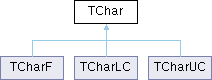
Holds a character value and provides a number of utility functions to manipulate it and test its properties. More...
#include <e32cmn.h>
Classes | |
| struct | TCharInfo |
| A structure to hold information about a Unicode character. More... | |
Public Types | |
| enum | TCategory { EAlphaGroup = 0x00 , ELetterOtherGroup = 0x10 , ELetterModifierGroup = 0x20 , EMarkGroup = 0x30 , ENumberGroup = 0x40 , EPunctuationGroup = 0x50 , ESymbolGroup = 0x60 , ESeparatorGroup = 0x70 , EControlGroup = 0x80 , EMaxAssignedGroup = 0xE0 , EUnassignedGroup = 0xF0 , ELuCategory = EAlphaGroup | 0 , ELlCategory = EAlphaGroup | 1 , ELtCategory = EAlphaGroup | 2 , ELoCategory = ELetterOtherGroup | 0 , EMaxLetterCategory = ELetterOtherGroup | 0x0F , ELmCategory = ELetterModifierGroup | 0 , EMaxLetterOrLetterModifierCategory = ELetterModifierGroup | 0x0F , EMnCategory = EMarkGroup | 0 , EMcCategory = EMarkGroup | 1 , EMeCategory = EMarkGroup | 2 , ENdCategory = ENumberGroup | 0 , ENlCategory = ENumberGroup | 1 , ENoCategory = ENumberGroup | 2 , EPcCategory = EPunctuationGroup | 0 , EPdCategory = EPunctuationGroup | 1 , EPsCategory = EPunctuationGroup | 2 , EPeCategory = EPunctuationGroup | 3 , EPiCategory = EPunctuationGroup | 4 , EPfCategory = EPunctuationGroup | 5 , EPoCategory = EPunctuationGroup | 6 , ESmCategory = ESymbolGroup | 0 , EScCategory = ESymbolGroup | 1 , ESkCategory = ESymbolGroup | 2 , ESoCategory = ESymbolGroup | 3 , EMaxGraphicCategory = ESymbolGroup | 0x0F , EZsCategory = ESeparatorGroup | 0 , EMaxPrintableCategory = EZsCategory , EZlCategory = ESeparatorGroup | 1 , EZpCategory = ESeparatorGroup | 2 , ECcCategory = EControlGroup | 0 , ECfCategory = EControlGroup | 1 , EMaxAssignedCategory = EMaxAssignedGroup | 0x0F , ECsCategory = EUnassignedGroup | 0 , ECoCategory = EUnassignedGroup | 1 , ECnCategory = EUnassignedGroup | 2 } |
| General Unicode character category. More... | |
| enum | TBdCategory { ELeftToRight , ELeftToRightEmbedding , ELeftToRightOverride , ERightToLeft , ERightToLeftArabic , ERightToLeftEmbedding , ERightToLeftOverride , EPopDirectionalFormat , EEuropeanNumber , EEuropeanNumberSeparator , EEuropeanNumberTerminator , EArabicNumber , ECommonNumberSeparator , ENonSpacingMark , EBoundaryNeutral , EParagraphSeparator , ESegmentSeparator , EWhitespace , EOtherNeutral } |
| The bi-directional Unicode character category. More... | |
| enum | TCjkWidth { ENeutralWidth , EHalfWidth , EFullWidth , ENarrow , EWide } |
| Notional character width as known to East Asian (Chinese, Japanese, Korean (CJK)) coding systems. More... | |
| enum | TEncoding { EUnicode , EShiftJIS } |
| enum | { EFoldCase = 1 , EFoldAccents = 2 , EFoldDigits = 4 , EFoldSpaces = 8 , EFoldKana = 16 , EFoldWidth = 32 , EFoldStandard = EFoldCase | EFoldAccents | EFoldDigits | EFoldSpaces , EFoldAll = -1 } |
| Flags defining operations to be performed using TChar::Fold(). More... | |
Public Member Functions | |
| TChar () | |
| Default constructor. | |
| TChar (TUint aChar) | |
| Constructs this character object and initialises it with the specified value. | |
| TChar & | operator-= (TUint aChar) |
| Subtracts an unsigned integer value from this character object. | |
| TChar & | operator+= (TUint aChar) |
| Adds an unsigned integer value to this character object. | |
| TChar | operator- (TUint aChar) |
| Gets the result of subtracting an unsigned integer value from this character object. | |
| TChar | operator+ (TUint aChar) |
| Gets the result of adding an unsigned integer value to this character object. | |
| operator TUint () const | |
| Gets the value of the character as an unsigned integer. | |
| void | Fold () |
| Converts the character to a form which can be used in tolerant comparisons without control over the operations performed. | |
| void | LowerCase () |
| Converts the character to its lowercase form. | |
| void | UpperCase () |
| Converts the character to its uppercase form. | |
| TBool | Eos () const |
| Tests whether the character is the C/C++ end-of-string character - 0. | |
| IMPORT_C TUint | GetUpperCase () const |
| Gets the character value after conversion to uppercase or the character's own value, if no uppercase form exists. | |
| IMPORT_C TUint | GetLowerCase () const |
| Gets the character value after conversion to lowercase or the character's own value, if no lowercase form exists. | |
| IMPORT_C TBool | IsLower () const |
| Tests whether the character is lowercase. | |
| IMPORT_C TBool | IsUpper () const |
| Tests whether the character is uppercase. | |
| IMPORT_C TBool | IsAlpha () const |
| Tests whether the character is alphabetic. | |
| IMPORT_C TBool | IsDigit () const |
| Tests whether the character is a standard decimal digit. | |
| IMPORT_C TBool | IsAlphaDigit () const |
| Tests whether the character is alphabetic or a decimal digit. | |
| IMPORT_C TBool | IsHexDigit () const |
| Tests whether the character is a hexadecimal digit (0-9, a-f, A-F). | |
| IMPORT_C TBool | IsSpace () const |
| Tests whether the character is a white space character. | |
| IMPORT_C TBool | IsPunctuation () const |
| Tests whether the character is a punctuation character. | |
| IMPORT_C TBool | IsGraph () const |
| Tests whether the character is a graphic character. | |
| IMPORT_C TBool | IsPrint () const |
| Tests whether the character is a printable character. | |
| IMPORT_C TBool | IsControl () const |
| Tests whether the character is a control character. | |
| void | Fold (TInt aFlags) |
| Converts the character to a form which can be used in tolerant comparisons allowing selection of the specific fold operations to be performed. | |
| void | TitleCase () |
| Converts the character to its titlecase form. | |
| IMPORT_C TUint | GetTitleCase () const |
| Gets the character value after conversion to titlecase or the character's own value, if no titlecase form exists. | |
| IMPORT_C TBool | IsTitle () const |
| Tests whether this character is in titlecase. | |
| IMPORT_C TBool | IsAssigned () const |
| Tests whether this character has an assigned meaning in the Unicode encoding. | |
| IMPORT_C void | GetInfo (TCharInfo &aInfo) const |
| Gets this character;s standard category information. | |
| IMPORT_C TCategory | GetCategory () const |
| Gets this character's Unicode category. | |
| IMPORT_C TBdCategory | GetBdCategory () const |
| Gets the bi-directional category of a character. | |
| IMPORT_C TInt | GetCombiningClass () const |
| Gets this character's combining class. | |
| IMPORT_C TBool | IsMirrored () const |
| Tests whether this character has the mirrored property. | |
| IMPORT_C TInt | GetNumericValue () const |
| Gets the integer numeric value of this character. | |
| IMPORT_C TCjkWidth | GetCjkWidth () const |
| Gets the Chinese, Japanese, Korean (CJK) notional width. | |
| IMPORT_C TBool | Decompose (TPtrC16 &aResult) const |
| Maps this character to its maximal canonical decomposition. | |
Static Public Member Functions | |
| static IMPORT_C TBool | Compose (TUint &aResult, const TDesC16 &aSource) |
| Composes a string of Unicode characters to produce a single character result. | |
| static TBool | IsSupplementary (TUint aChar) |
| static TBool | IsSurrogate (TText16 aInt16) |
| static TBool | IsHighSurrogate (TText16 aInt16) |
| static TBool | IsLowSurrogate (TText16 aInt16) |
| static TUint | JoinSurrogate (TText16 aHighSurrogate, TText16 aLowSurrogate) |
| Combine a high surrogate and a low surrogate into a supplementary character. | |
| static TText16 | GetHighSurrogate (TUint aChar) |
| Retrieve the high surrogate of a supplementary character. | |
| static TText16 | GetLowSurrogate (TUint aChar) |
| Retrieve the low surrogate of a supplementary character. | |
Protected Member Functions | |
| void | SetChar (TUint aChar) |
Detailed Description
Holds a character value and provides a number of utility functions to manipulate it and test its properties.
For example, there are functions to convert the character to uppercase and test whether or not it is a control character.
The character value is stored as a 32-bit unsigned integer. The shorthand "TChar value" is used to describe the character value wrapped by a TChar object.
TChar can be used to represent Unicode values outside plane 0 (that is, the extended Unicode range from 0x10000 to 0xFFFFF). This differentiates it from TText which can only be used for 16-bit Unicode character values.
- See also
- TText
- API status
- Published to all clients. Released API.
Member Enumeration Documentation
◆ anonymous enum
| anonymous enum |
Flags defining operations to be performed using TChar::Fold().
The flag values are passed to the Fold() funtion.
- See also
- TChar::Fold
| Enumerator | |
|---|---|
| EFoldCase | Convert characters to their lower case form if any. |
| EFoldAccents | Strip accents. |
| EFoldDigits | Convert digits representing values 0..9 to characters '0'..'9'. |
| EFoldSpaces | Convert all spaces (ordinary, fixed-width, ideographic, etc.) to ' '. |
| EFoldKana | Convert hiragana to katakana. |
| EFoldWidth | Fold fullwidth and halfwidth variants to their standard forms. |
| EFoldStandard | Perform standard folding operations, i.e.those done by Fold() with no argument. |
| EFoldAll | Perform all possible folding operations. |
◆ TBdCategory
| enum TChar::TBdCategory |
The bi-directional Unicode character category.
For more information on the bi-directional algorithm, see Unicode Technical Report No. 9 available at: http://www.unicode.org/unicode/reports/tr9.
◆ TCategory
| enum TChar::TCategory |
General Unicode character category.
The high nibble encodes the major category (Mark, Number, etc.) and a low nibble encodes the subdivisions of that category.
The category codes can be used in three ways:
(i) as unique constants: there is one for each Unicode category, with a name of the form
where
is the category name given by the Unicode database (e.g., the constant ELuCategory is used for lowercase letters, category Lu);
(ii) as numbers in certain ranges: letter categories are all <= EMaxLetterCategory;
(iii) as codes in which the upper nibble gives the category group (e.g., punctuation categories all yield TRUE for the test (category & 0xF0) ==EPunctuationGroup).
| Enumerator | |
|---|---|
| EAlphaGroup | Alphabetic letters. Includes ELuCategory, ELlCategory and ELtCategory. |
| ELetterOtherGroup | Other letters. Includes ELoCategory. |
| ELetterModifierGroup | Letter modifiers. Includes ELmCategory. |
| EMarkGroup | Marks group. Includes EMnCategory, EMcCategory and EMeCategory. |
| ENumberGroup | Numbers group. Includes ENdCategory, ENlCategory and ENoCategory. |
| EPunctuationGroup | Punctuation group. IncludesEPcCategory, PdCategory, EpeCategory, EPsCategory and EPoCategory. |
| ESymbolGroup | Symbols group. Includes ESmCategory, EScCategory, ESkCategory and ESoCategory. |
| ESeparatorGroup | Separators group. Includes EZsCategory, EZlCategory and EZlpCategory. |
| EControlGroup | Control, format, private use, unassigned. Includes ECcCategory, ECtCategory, ECsCategory, ECoCategory and ECnCategory. |
| EMaxAssignedGroup | The highest possible groups category. |
| EUnassignedGroup | Unassigned to any other group. |
| ELuCategory | Letter, Uppercase. |
| ELlCategory | Letter, Lowercase. |
| ELtCategory | Letter, Titlecase. |
| ELoCategory | Letter, Other. |
| EMaxLetterCategory | The highest possible (non-modifier) letter category. |
| ELmCategory | Letter, Modifier. |
| EMaxLetterOrLetterModifierCategory | The highest possible letter category. |
| EMnCategory | Mark, Non-Spacing. |
| EMcCategory | Mark, Combining. |
| EMeCategory | Mark, Enclosing. |
| ENdCategory | Number, Decimal Digit. |
| ENlCategory | Number, Letter. |
| ENoCategory | Number, Other. |
| EPcCategory | Punctuation, Connector. |
| EPdCategory | Punctuation, Dash. |
| EPsCategory | Punctuation, Open. |
| EPeCategory | Punctuation, Close. |
| EPiCategory | Punctuation, Initial Quote. |
| EPfCategory | Punctuation, Final Quote. |
| EPoCategory | Punctuation, Other. |
| ESmCategory | Symbol, Math. |
| EScCategory | Symbol, Currency. |
| ESkCategory | Symbol, Modifier. |
| ESoCategory | Symbol, Other. |
| EMaxGraphicCategory | The highest possible graphic character category. |
| EZsCategory | Separator, Space. |
| EMaxPrintableCategory | The highest possible printable character category. |
| EZlCategory | Separator, Line. |
| EZpCategory | Separator, Paragraph. |
| ECcCategory | Other, Control. |
| ECfCategory | Other, Format. |
| EMaxAssignedCategory | The highest possible category for assigned 16-bit characters; does not include surrogates, which are interpreted as pairs and have no meaning on their own. |
| ECsCategory | Other, Surrogate. |
| ECoCategory | Other, Private Use. |
| ECnCategory | Other, Not Assigned. |
◆ TCjkWidth
| enum TChar::TCjkWidth |
Notional character width as known to East Asian (Chinese, Japanese, Korean (CJK)) coding systems.
◆ TEncoding
| enum TChar::TEncoding |
Constructor & Destructor Documentation
◆ TChar() [1/2]
|
inline |
Default constructor.
Constructs this character object with an undefined value.
(generated from Symbian Developer Library)
◆ TChar() [2/2]
|
inline |
Constructs this character object and initialises it with the specified value.
- Parameters
-
aChar The initialisation value.
(generated from Symbian Developer Library)
Member Function Documentation
◆ Compose()
|
static |
Composes a string of Unicode characters to produce a single character result.
For example, 0061 ('a') and 030A (combining ring above) compose to give 00E5 ('a' with ring above).
A canonical decomposition is a relationship between a string of characters - usually a base character and one or more diacritics - and a composed character. The Unicode standard requires that compliant software treats composed characters identically with their canonical decompositions. The mappings used by these functions are fixed and cannot be overridden for particular locales.
- Parameters
-
aResult If successful, the composed character value. If unsuccessful, this value contains 0xFFFF. aSource String of source Unicode characters.
(generated from Symbian Developer Library)
◆ Decompose()
| IMPORT_C TBool TChar::Decompose | ( | TPtrC16 & | aResult | ) | const |
Maps this character to its maximal canonical decomposition.
For example, 01E1 ('a' with dot above and macron) decomposes into 0061 ('a') 0307 (dot) and 0304 (macron).
Note that this function is used during collation, as performed by the Mem::CompareC() function, to convert the compared strings to their maximal canonical decompositions.
Mem::CompareC() TChar::Compose()
- Parameters
-
aResult If successful, the descriptor represents the canonical decomposition of this character. If unsuccessful, the descriptor is empty.
(generated from Symbian Developer Library)
◆ Eos()
|
inline |
Tests whether the character is the C/C++ end-of-string character - 0.
(generated from Symbian Developer Library)
◆ Fold() [1/2]
|
inline |
Converts the character to a form which can be used in tolerant comparisons without control over the operations performed.
Tolerant comparisons are those which ignore character differences like case and accents.
This function can be used when searching for a string in a text file or a file in a directory. Folding performs the following conversions: converts to lowercase, strips accents, converts all digits representing the values 0..9 to the ordinary digit characters '0'..'9', converts all spaces (standard, non-break, fixed-width, ideographic, etc.) to the ordinary space character (0x0020), converts Japanese characters in the hiragana syllabary to katakana, and converts East Asian halfwidth and fullwidth variants to their ordinary forms. You can choose to perform any subset of these operations by using the other function overload.
(generated from Symbian Developer Library)
◆ Fold() [2/2]
|
inline |
Converts the character to a form which can be used in tolerant comparisons allowing selection of the specific fold operations to be performed.
- Parameters
-
aFlags Flags which define the operations to be performed. The values are defined in the enum beginning with EFoldCase.
(generated from Symbian Developer Library)
◆ GetBdCategory()
| IMPORT_C TBdCategory TChar::GetBdCategory | ( | ) | const |
Gets the bi-directional category of a character.
For more information on the bi-directional algorithm, see Unicode Technical Report No. 9 available at: http://www.unicode.org/unicode/reports/tr9/.
(generated from Symbian Developer Library)
◆ GetCategory()
| IMPORT_C TCategory TChar::GetCategory | ( | ) | const |
Gets this character's Unicode category.
(generated from Symbian Developer Library)
◆ GetCjkWidth()
| IMPORT_C TCjkWidth TChar::GetCjkWidth | ( | ) | const |
Gets the Chinese, Japanese, Korean (CJK) notional width.
Some display systems used in East Asia display characters on a grid of fixed-width character cells like the standard MSDOS display mode.
Some characters, e.g. the Japanese katakana syllabary, take up a single character cell and some characters, e.g., kanji, Chinese characters used in Japanese, take up two. These are called half-width and full-width characters. This property is fixed and cannot be overridden for particular locales.
For more information on returned widths, see Unicode Technical Report 11 on East Asian Width available at: http://www.unicode.org/unicode/reports/tr11/
(generated from Symbian Developer Library)
◆ GetCombiningClass()
| IMPORT_C TInt TChar::GetCombiningClass | ( | ) | const |
Gets this character's combining class.
Note that diacritics and other combining characters have non-zero combining classes.
(generated from Symbian Developer Library)
◆ GetHighSurrogate()
|
inlinestatic |
Retrieve the high surrogate of a supplementary character.
- Parameters
-
aChar The 32-bit code point value of a Unicode character.
- Returns
- High surrogate of aChar, if aChar is a supplementary character; aChar itself, if aChar is not a supplementary character.
- See also
- TChar::GetLowSurrogate
(generated from Original Symbian implementation)
◆ GetInfo()
| IMPORT_C void TChar::GetInfo | ( | TCharInfo & | aInfo | ) | const |
Gets this character;s standard category information.
This includes everything except its CJK width and decomposition, if any.
- Parameters
-
aInfo On return, contains the character's standard category information.
(generated from Symbian Developer Library)
◆ GetLowerCase()
| IMPORT_C TUint TChar::GetLowerCase | ( | ) | const |
Gets the character value after conversion to lowercase or the character's own value, if no lowercase form exists.
The character object itself is not changed.
(generated from Symbian Developer Library)
◆ GetLowSurrogate()
|
inlinestatic |
Retrieve the low surrogate of a supplementary character.
- Parameters
-
aChar The 32-bit code point value of a Unicode character.
- Returns
- Low surrogate of aChar, if aChar is a supplementary character; zero, if aChar is not a supplementary character.
- See also
- TChar::GetHighSurrogate
(generated from Original Symbian implementation)
◆ GetNumericValue()
| IMPORT_C TInt TChar::GetNumericValue | ( | ) | const |
Gets the integer numeric value of this character.
Numeric values need not be in the range 0..9; the Unicode character set includes various other numeric characters such as the Roman and Tamil numerals for 500, 1000, etc.
(generated from Symbian Developer Library)
◆ GetTitleCase()
| IMPORT_C TUint TChar::GetTitleCase | ( | ) | const |
Gets the character value after conversion to titlecase or the character's own value, if no titlecase form exists.
The titlecase form of a character is identical to its uppercase form unless a specific titlecase form exists.
(generated from Symbian Developer Library)
◆ GetUpperCase()
| IMPORT_C TUint TChar::GetUpperCase | ( | ) | const |
Gets the character value after conversion to uppercase or the character's own value, if no uppercase form exists.
The character object itself is not changed.
(generated from Symbian Developer Library)
◆ IsAlpha()
| IMPORT_C TBool TChar::IsAlpha | ( | ) | const |
Tests whether the character is alphabetic.
For Unicode, the function returns TRUE for all letters, including those from syllabaries and ideographic scripts. The function returns FALSE for letter-like characters that are in fact diacritics. Specifically, the function returns TRUE for categories: ELuCategory, ELtCategory, ELlCategory, and ELoCategory; it returns FALSE for all other categories including ELmCategory.
TChar::IsAlphaDigit() TChar::TCategory
(generated from Symbian Developer Library)
◆ IsAlphaDigit()
| IMPORT_C TBool TChar::IsAlphaDigit | ( | ) | const |
Tests whether the character is alphabetic or a decimal digit.
It is identical to (IsAlpha()||IsDigit()).
TChar::IsAlpha() TChar::IsDigit()
(generated from Symbian Developer Library)
◆ IsAssigned()
| IMPORT_C TBool TChar::IsAssigned | ( | ) | const |
Tests whether this character has an assigned meaning in the Unicode encoding.
All characters outside the range 0x0000 - 0xFFFF are unassigned and there are also many unassigned characters within the Unicode range.
Locales can change the assigned/unassigned status of characters. This means that the precise behaviour of this function is locale-dependent.
(generated from Symbian Developer Library)
◆ IsControl()
| IMPORT_C TBool TChar::IsControl | ( | ) | const |
Tests whether the character is a control character.
For Unicode, the function returns TRUE for all characters in the categories: ECcCategory, ECfCategory, ECsCategory, ECoCategory and ECnCategoryCc.
(generated from Symbian Developer Library)
◆ IsDigit()
| IMPORT_C TBool TChar::IsDigit | ( | ) | const |
Tests whether the character is a standard decimal digit.
For Unicode, this function returns TRUE only for the digits '0'...'9' (U+0030...U+0039), not for other digits in scripts like Arabic, Tamil, etc.
TChar::GetCategory() TChar::GetNumericValue
(generated from Symbian Developer Library)
◆ IsGraph()
| IMPORT_C TBool TChar::IsGraph | ( | ) | const |
Tests whether the character is a graphic character.
For Unicode, graphic characters include printable characters but not the space character. Specifically, graphic characters are any character except those in categories: EZsCategory,EZlCategory,EZpCategory, ECcCategory,ECfCategory, ECsCategory, ECoCategory, and ,ECnCategory.
Note that for ISO Latin-1, all alphanumeric and punctuation characters are graphic.
(generated from Symbian Developer Library)
◆ IsHexDigit()
| IMPORT_C TBool TChar::IsHexDigit | ( | ) | const |
Tests whether the character is a hexadecimal digit (0-9, a-f, A-F).
(generated from Symbian Developer Library)
◆ IsHighSurrogate()
|
inlinestatic |
- Returns
- True, if aText16 is high surrogate; false, otherwise.
(generated from Original Symbian implementation)
◆ IsLower()
| IMPORT_C TBool TChar::IsLower | ( | ) | const |
Tests whether the character is lowercase.
(generated from Symbian Developer Library)
◆ IsLowSurrogate()
|
inlinestatic |
- Returns
- True, if aText16 is low surrogate; false, otherwise.
(generated from Original Symbian implementation)
◆ IsMirrored()
| IMPORT_C TBool TChar::IsMirrored | ( | ) | const |
Tests whether this character has the mirrored property.
Mirrored characters, like ( ) [ ] < >, change direction according to the directionality of the surrounding characters. For example, an opening parenthesis 'faces right' in Hebrew or Arabic, and to say that 2 < 3 you would have to say that 3 > 2, where the '>' is, in this example, a less-than sign to be read right-to-left.
(generated from Symbian Developer Library)
◆ IsPrint()
| IMPORT_C TBool TChar::IsPrint | ( | ) | const |
Tests whether the character is a printable character.
For Unicode, printable characters are any character except those in categories: ECcCategory, ECfCategory, ECsCategory, ECoCategory and ECnCategory.
Note that for ISO Latin-1, all alphanumeric and punctuation characters, plus space, are printable.
(generated from Symbian Developer Library)
◆ IsPunctuation()
| IMPORT_C TBool TChar::IsPunctuation | ( | ) | const |
Tests whether the character is a punctuation character.
For Unicode, punctuation characters are any character in the categories: EPcCategory, EPdCategory, EPsCategory, EPeCategory, EPiCategory, EPfCategory, EPoCategory.
(generated from Symbian Developer Library)
◆ IsSpace()
| IMPORT_C TBool TChar::IsSpace | ( | ) | const |
Tests whether the character is a white space character.
White space includes spaces, tabs and separators.
For Unicode, the function returns TRUE for all characters in the categories: EZsCategory, EZlCategory and EZpCategory, and also for the characters 0x0009 (horizontal tab), 0x000A (linefeed), 0x000B (vertical tab), 0x000C (form feed), and 0x000D (carriage return).
(generated from Symbian Developer Library)
◆ IsSupplementary()
|
inlinestatic |
- Parameters
-
aChar The 32-bit code point value of a Unicode character.
- Returns
- True, if aChar is supplementary character; false, otherwise.
(generated from Original Symbian implementation)
◆ IsSurrogate()
|
inlinestatic |
- Returns
- True, if aText16 is high surrogate or low surrogate; false, otherwise.
(generated from Original Symbian implementation)
◆ IsTitle()
| IMPORT_C TBool TChar::IsTitle | ( | ) | const |
Tests whether this character is in titlecase.
(generated from Symbian Developer Library)
◆ IsUpper()
| IMPORT_C TBool TChar::IsUpper | ( | ) | const |
Tests whether the character is uppercase.
(generated from Symbian Developer Library)
◆ JoinSurrogate()
|
inlinestatic |
Combine a high surrogate and a low surrogate into a supplementary character.
- Returns
- The 32-bit code point value of the generated Unicode supplementary character.
(generated from Original Symbian implementation)
◆ LowerCase()
|
inline |
Converts the character to its lowercase form.
Characters lacking a lowercase form are unchanged.
(generated from Symbian Developer Library)
◆ operator TUint()
|
inline |
Gets the value of the character as an unsigned integer.
The operator casts a TChar to a TUint, returning the TUint value wrapped by this character object.
(generated from Symbian Developer Library)
◆ operator+()
|
inline |
Gets the result of adding an unsigned integer value to this character object.
This character object is not changed.
- Parameters
-
aChar The value to be added.
(generated from Symbian Developer Library)
◆ operator+=()
|
inline |
Adds an unsigned integer value to this character object.
This character object is changed by the operation.
- Parameters
-
aChar The value to be added.
(generated from Symbian Developer Library)
◆ operator-()
|
inline |
Gets the result of subtracting an unsigned integer value from this character object.
This character object is not changed.
- Parameters
-
aChar The value to be subtracted.
(generated from Symbian Developer Library)
◆ operator-=()
|
inline |
Subtracts an unsigned integer value from this character object.
This character object is changed by the operation.
- Parameters
-
aChar The value to be subtracted.
(generated from Symbian Developer Library)
◆ SetChar()
|
inlineprotected |
◆ TitleCase()
|
inline |
Converts the character to its titlecase form.
The titlecase form of a character is identical to its uppercase form unless a specific titlecase form exists. Characters lacking a titlecase form are unchanged.
(generated from Symbian Developer Library)
◆ UpperCase()
|
inline |
Converts the character to its uppercase form.
Characters lacking an uppercase form are unchanged.
(generated from Symbian Developer Library)
The documentation for this class was generated from the following files: